Saturday, May 26, 2012

(STICKY) (NYASATIMES) Implementing the national austerity drive in Malawi

COMMENT - Joyce Banda is going all out and implementing all the IMF and World Bank pleasing policies that Bingu wa Mutharika resisted. This is not democracy at work, it is another coup by the IMF and World Bank.

Implementing the national austerity drive in Malawi
By Rhodrick Junaid Kalumpha

In her maiden State of the Nation Address on 18th May 2012 President Joyce Banda, stated that as a first priority, her government is going to “launch a national austerity drive” by cutting government expenditure through a number of on-going measures. This is a very interesting policy that needs to be analyzed thoroughly as it can unlock a great potential that has been lacking in the Malawi's economy since the dawn of multiparty democracy.

Under the austerity economic policy, the Government will aim at reducing the projected budget deficit of MK59.7billion which according to the president, was mainly financed through borrowing from the Reserve Bank of Malawi. However, austerity can also be achieved through increases in government revenues primarily via tax rises. Unfortunately, Malawians are already overtaxed, thus cutting back on government spending is the only option through which the austerity policy can be implemented.

By their nature of cutting government spending on public services and or increasing taxes, austerity measures are usually not popular with the general public. People loathe them the world over and they have been known to bring down elected governments.

[HINT! This is not democracy at work. And it has no record of economic success. The people don't want it and it doesn't work - why implement it? It is something much more sinister. - MrK]


Recent example is that of former President of France, Mr Nicolas Sarkozy who was voted out of office after only one term with austerity measures as one of the causes. Fortunately, with the abysmal state of our economy coupled with underperforming statutory corporations’ management living largesse, everyone would agree that we need to bring in the spanners to tighten our economic belts.

Another disparagement of austerity is that it asphyxiates the much needed economic growth. When the rating agency Standard & Poor’s (one of the three big credit rating agencies in the world) downgraded France and other Eurozone countries’ credit rating, it stated that "austerity alone risks becoming self-defeating, since domestic demand falls in line with consumers" rising concerns about job security and disposable incomes and eroding national tax revenues. Thus austerity can become counterproductive to the very objectives it is supposed to achieve. Under austerity, domestic demand usually declines as the public feel the pinch of the government spending cuts. The private sector is also usually not spared as business falters and confidence falls since Government is the single largest spender in an economy.

Unfortunately, with the sorry state of our economy, austerity measures are not inevitable.

[Ever consider that it was austerity that caused the present state of the economy, and of course retaliation against the government by the IMF/World Bank/Donors for not implementing austerity and, for instance, supporting farmers with a fertilizer subsidy, as well as extending a business loan to the Government of Zimbabwe, a country that supposedly is 'not under economic sanctions'? - MrK]


We must cut back on unnecessary government spending and trim the perks of executive management of our statutory corporations. The President stated that among other issues to be looked at will include the size of her convoy, overseas travel and the contentious issue of the presidential jet. She clearly stated that the Minister of Finance will announce more of these measures in detail when the budget is presented. Malawians will be waiting with bated breaths to see what else will receive the chop. Hopefully, the measures will include forbidding of construction of car parking lots at MK54million or swimming pools at MK40million by statutory corporations through dodgy contracts.

[That's not 'government spending', that is corruption. - MrK]


The measures should also forbid the practice of statutory corporations CEOs attendance at the Airport every time the president is travelling or coming back. Not only are we spending money on such useless protocols, we are also losing productivity as valuable management time is lost.

One former CEO of MIPA, once lamented that he never used to attend these airport pageantries so much so that it angered the ruling elites in the UDF regime. He was eventually sacked of course this being one of the many reasons. We wish Malawi had many CEOs of such caliber. In addition, hefty entertainment and personal allowances of statutory corporations’ management must be reduced.

There is no need to pay Executives allowances just for attending a meeting in a city where their office is not located. This is absurd to say the least since it is part of their jobs. Some corporations even buy food items for their top managers, pay their cooks, have allowances for dogs, their spouses are allocated company cars and kids are chauffer-driven to schools and parties. This is ridiculous and callous to millions of Malawians who struggle everyday just to get by.

Furthermore, our embassies need to be revamped to achieve efficiency. The practice of sending people willy-nilly to embassies just to stamp receipts as “PAID” as their job description while paying them hefty salaries must be scrapped. There is also massive duplication of roles in our embassies. For instance, the Tourism Attaché can equally handle the public relations portfolio, equally, the Trade attaché can handle investments, hence no need to send four individuals for these roles which need only two. It is also important to curb the excessive lodging allowances that the staffs are paid in such embassies. For instance, it is a sheer waste of public resources to pay circa USD5000 per month for accommodation and bills for a junior “diplomat” whose only job is to stamp receipts as “PAID”.

This must be curbed immediately. An alternative is for our embassies to employ local staffs who are far much more cost-effective than bringing someone from home just because they are politically connected or the Government want to get rid of them from the system due to some well known scandal. This calls for immediate audits of our embassies to flush out both individuals who don’t deserve to be there and also cut back on excessive expenditure.

Last but not least, the ferrying of school teachers, students and civil servants to Government functions must be forbidden. Why do we need to have teachers and civil servants at Government functions that are not related to their roles? One would understand if the function is related to the role of the civil servant or the teacher or the student. Even in that case, we don’t need the entire department or the whole schoolto be there, just the key officers would be enough. We lose both productivity and money with such unnecessary pageantries. Therefore, it is imperative that spending be targeted at boosting economic growth.

However, in our case, it is also question of how savings are made and the above are some of the ways that we could attain savings. The list is too long to exhaust here. As Olli Rehn, the European Union’s commissioner for economic and monetary affairs once asserted, fiscal consolidation, while necessary, must be done in a growth-friendly and differentiated way, in order to strike a balance between necessary fiscal consolidation and concerns for growth.

Fortunately in Malawi’s case, most of our excesses will not affect growth in any way, thus we can cut back as much as we can and perhaps reduce the budget deficit by almost half in the next 18 months. The time to do this is now and we must not procrastinate as our economy is bleeding heavily. Austerity must be the part of the concoction with only core services such as health, education, defense and agriculture ring-fenced from such measures.

Labels: , ,


Read more...

(STICKY) Chikwanka backs CSO's calls for windfall tax

Chikwanka backs CSO's calls for windfall tax
By Gift Chanda
Sat 26 May 2012, 12:43 CAT

ANY democratically-elected government that sets conditions to only favour investors betrays its people, says Council of Churches social and economic justice programme officer Nsama Chikwanka.

Commenting on calls by civil society organisations to reintroduce windfall tax in the mining sector, Chikwanka, a development expert, said there is need for the government to stop protecting the interests of investors at the expense of the people that ushered them into power.

Civil society organisations have stepped up calls for the reintroduction of the windfall tax on mines as the PF government prepares its first wholly developed national budget.

He said it is important for the government to establish that a country can only develop from the prudent utilisation of its various resources, both human and natural.

In this case, Chikwanka said the principal beneficiaries of Zambia's natural resource endowments should be Zambians and anything short of that is short-changing the owners of the land.

"It is betrayal of its people for a democratically-elected government to set conditions that support or favour the investors," Chikwanka said in an emailed response to a query.

"The story about ensuring that the goose is not killed should be viewed also from the point that we should not let the geese become so powerful as to start dictating how many eggs it should contribute. Any investment should not disadvantage locals."

He pointed out that at the moment, apart from the huge holes, traffic jams, finished roads, increased pollution and interim media statements, there is nothing to show for the boom in the mining sector.

"A walk to the Copperbelt tells the whole story; all roads leading to all major mining towns are in deplorable state and are death traps," Chikwanka said.

"The government needs to start governing instead of protecting the interests of investors."

He called on the government to involve everyone in the country's development agenda.

"Our greatest challenge is the unclear tax system for the country. Firstly, there are so many taxes in the sector, some of which are conflicting, and are responsible for the misunderstanding that is created when companies start giving their total contribution to the treasury. We need tax policies and systems that can be understood by all; at the moment, there is a system that works for and is only understood by government and sector investors. The current discourse is confusing to the common Zambian who is left to wonder how tax experts have failed to agree on this concept," Chikwanka said.

"So the challenge is for Zambia to harmonise its tax system that will be clear for all because at the moment, only the government and investors claim to understand what taxes are collected and how much.

"Any tax information that is coming from civil society and other interest groups is disputed."

He further noted that the other compounding factor to the whole tax debate in the mining sector is the secrecy surrounding the mining agreements.

International Monetary Fund country representative Perry Perone recently revealed that the Zambian government had agreed to conduct a comprehensive review of the mining tax regime.

"Until the government comes in the open to state the nature of the mining agreements, Zambians are justified in their speculations and cannot be blamed for concluding there is corruption and abuse of authority in the whole process," said Chikwanka.

Labels: , , , , ,


Read more...

Friday, May 25, 2012

(NEWZIMBABWE) UN rights chief calls for lifting of Zimbabwe sanctions

COMMENT - Human rights fact finding mission on the bleeding obvious - that economic sanctions make the lives of the poor so miserable that they turn on their own leadership. Half a million women and children died because of the sanctions on Iraq (also see here)- why would Zimbabwe fare any better?

UN rights chief calls for lifting of Zimbabwe sanctions
Zimbabwe visit ... Pillay meeting President Mugabe in Harare on Wednesday
25/05/2012 00:00:00
by Staff Reporter

UNITED Nations human rights chief Navi Pillay on Friday called on the European Union and the United States to lift sanctions on Zimbabwe, saying they have worsened the country’s economic problems with “quite serious ramifications” for the poorest and most vulnerable.

Pillay said allegations of human rights abuses cited by western countries when imposing the sanctions should be dealt with in a court of law, not through measures that affect ordinary people.

“The issues relating to the individuals targeted by the sanctions will, I hope – assuming there is sufficient evidence – one day be sorted out in a court of law, which is the proper place to deal with serious crimes,” she said during a lecture at the University of Zimbabwe.

“In the meantime, I would urge those countries that are currently applying sanctions on Zimbabwe to suspend them, at least until the conduct and outcome of the elections and related reforms are clear.”

The United States and the European Union imposed sanctions against Zimbabwe more than a decade ago, accusing President Robert Mugabe and key figures in his administration of gross human rights abuses and electoral fraud.

[And encroaching on the lands owend by De Beers, like the 117,000 hectare Debshan 'Ranch'. - MrK]


Mugabe denies the allegations and claims the sanctions were meant to punish him and his Zanu PF party for the country’s land reforms. The Zanu PF leader blames the sanctions for the country’s near-economic collapse over the last few years.

Western countries blame mismanagement for the country’s economic challenges and insist that the sanctions are only targeted at individuals and corporations linked to the alleged abuses.

[How can ZDERA be 'only targeted at individuals and corporations linked to the alleged abuses.'? Let's revisit their language, ZDERA Section 4 C:

SEC. 4. SUPPORT FOR DEMOCRATIC TRANSITION AND ECONOMIC RECOVERY.

(c) MULTILATERAL FINANCING RESTRICTION- ... the Secretary of the Treasury shall instruct the United States executive director to each international financial institution to oppose and vote against--

(1) any extension by the respective institution of any loan, credit, or guarantee to the Government of Zimbabwe; or

(2) any cancellation or reduction of indebtedness owed by the Government of Zimbabwe to the United States or any international financial institution.

Notice that the term "the Government Of Zimbabwe" is mentioned TWICE. In other words, the claim that economic sanctions against Zimbabwe are limited to or aimed at "individuals and corporations linked to the alleged abuses" is an outright, documentable lie. The entire government of Zimbabwe (now including the MDC members) are subject to ZDERA. It was ZDERA that destroyed the Zimbabwe Dollar, destroying people's savings and salaries, by freezing the Government of Zimbabwe's lines of credit at international financial institutions, including the African Development Bank, African Development Fund, Asian Development Bank, etc (see Section 3 titled Definitions). The destruction of the Zimbabwe Dollar coincides perfectly with the coming into force of ZDERA on Jan. 1st 2002, the year the Zimbabwe Dollar fell as much against the US Dollar as in the previous 6 years combined. I would say that, and common sense, are conclusive proof that the Zimbabwe Dollar was destroyed by ZDERA. See this chart (correction, the chart says 31st December 2001 when it is Jan 1st 2002), and read this 2010 article.

Economic sanctions, through the Government of Zimbabwe, have ALWAYS been aimed at the people of Zimbabwe, to weaken their will and give Anglo-American De Beers a free hand at exploiting the people's diamonds through privatisation of the Chiadzwa and Marange diamond fields. - MrK]


But Pillay – whose five-day visit to Zimbabwe concluded on Friday – said the sanctions “are in fact having a wider impact on the general population”.

[No shit, Sherlock. In ms. Pillay's own words:

" According to the Zimbabwe Demographic Health Survey 2011, the Maternal Mortality rate now is at 960 per 100,000 live births, whereas in 2005-2006 it was at 555, an increase of more than forty percent in just six years. At the same time, the limited access to clean water has led to outbreaks of typhoid and cholera. "
Source: (NEWZIMBABWE) Full text: UN rights chief's lecture at University of Zimbabwe

I would say the Zimbabwean population has been the main target of economic sanctions, just as the Iraqi population was the target of economic sanctions back in the 1990s. - MrK]


“There seems little doubt that the existence of the sanctions regimes has, at the very least, acted as a serious disincentive to overseas banks and investors. It is also likely that the stigma of sanctions has limited certain imports and exports,” she said.

“Taken together, these and other unintended side-effects will in turn inevitably have had a negative impact on the economy at large, with possibly quite serious ramifications for the country’s poorest and most vulnerable populations who have also had to cope with the political instability and violence as well as a severe drought.”

Pillay said there was no reason for maintaining the sanctions when all the three parties to the coalition government were agreed that they should be removed.

“The continuation of sanctions is now opposed by all three parties that make up the inclusive government, and I have yet to hear a single Zimbabwean inside the country say they definitely think sanctions should continue,” she said.

“The reason for this is a perception that sanctions, which were targeted at various named individuals and companies, are in fact having a wider impact on the general population.

Labels: , ,


Read more...

(STICKY) Zambia needs reforms in agriculture - IMF

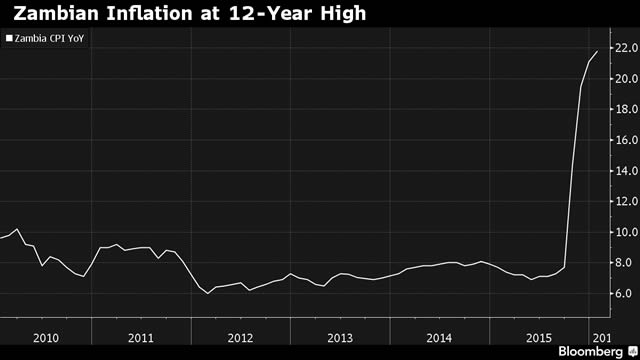
COMMENT - The words 'IMF' and 'advice' do not belong in the same sentence. You take advice from people with a long track record of success, whereas the IMF has a unbroken record of abject failure. If you count economic development as success, of course. If you are a trillionaire, they are right on track in making the people's resources available to them and them alone. The IMF should just shut up and ask how they can make reparations for past 'advice'. Like reparations for making Zambia miss out on the biggest run in copper prices, by privatising the mining industry, losing between $20 billion and $40 billion in lost mining profits over the last decade. Meanwhile ordinary Zambians face a liquidity gap of 2% savings rates and 21% lending rates. Now what is the IMF's 'plan' for that?

Zambia needs reforms in agriculture - IMF
By Moses Kuwema
Fri 25 May 2012, 13:29 CAT

DEPUTY director of the International Monetary Fund African department, Sean Nolan says Zambia needs reforms to lay the basis for pro-poor agricultural sector development to address the skill mismatch and to facilitate formal sector employment growth.

Nolan said this during the recently held International Conference on employment held at the Government Complex. Nolan said Zambia had achieved significant economic success over the past decade as measured by the Gross Domestic Product growth and other macroeconomic indicators.

He, however, said the record of converting output growth into poverty reduction and expansion of formal employment had been mixed.

Nolan said the national poverty rates still stood at about 63 per cent, while the share of the labour force engaged in low productivity subsistence activities might be growing.

['Low productivity' indeed. The difference is that they keep pretty much all of what they produce. - MrK]

And International Labour Organisation country director for Zambia Martin Clemensson said unemployment had grown across the country since the onset of the global financial crisis and estimated the rise in unemployment world-wide to be at 30 million since 2007.

He said there was need to incorporate employment creation into the formulation of macroeconomic policies to improve employment outcomes.

Meanwhile, workers representatives in a communiqué stated there was need to explore more creative and innovative approaches to job creation in sectors such as Information Communication Technology that offer potential for employment, according to the workers' movement.

The communiqué stated that the Ministry of Finance and the Bank of Zambia must include employment as a key indicator of monetary and fiscal policy.

The workers' representatives observed that this would ensure that employment and decent work were planned and were not treated as by-products of prudent macroeconomic management.

The communiqué further reads that availability of timely labour statistics should be promoted to provide data for effective policy planning.

The workers' representatives further called for the promotion of investment in infrastructure and public services as well as public employment schemes and also strengthening of labour legislation, inspection and enforcement to ensure workers' rights were effectively protected and casualisation was stopped especially among the youth.

Labels: , ,


Read more...

Thursday, May 24, 2012

(STICKY) (SUNDAY MAIL ZW) SA ruling: It’s time for an eye for an eye

COMMENT - I wouldn't be surprised at all if some or all of the 6 to 11 white farmers who killed during land reform, were killed by remnants of Super ZAPU and the Selous Scout types, revived as the MDC's Democratic Resistance Committees. They did the same in the 1980s to grab international headlines. Quote:
When in 2008, I was briefed by the security that there were bombings of police stations and burning of houses in rural areas, I quickly realised that we were not dealing with the MDC or any other political party, but this was the ugly head of the Selous Scouts trying to tarnish the image of Zanu-PF.
If they are using South African territory to plan criminal acts in Zimbabwe, they are liable under South African law too.

SA ruling: It’s time for an eye for an eye
Saturday, 19 May 2012 20:24
Sunday Mail Reporter

Diplomats from Southern Africa have said the time might have come for governments in the region to “square up” with former Rhodies and their influential friends in South Africa who are abusing democratic institutions in that country to continue their war against Zimbabwe in provocative ways that are now threatening to destabilise the region.

War veterans in this country have also added their voice, saying the former Rhodies and their friends in South Africa should know that “we are fully aware that they committed lots of unspeakable atrocities before our country’s independence and they continue to do so up to this day and so the time is fast approaching to return fire with fire.”

The concerns raised by the diplomats and the outrage from the war veterans follow a ruling handed down recently by Judge Hans Fabricius of North Gauteng High Court in South Africa calling on authorities in that country to probe alleged atrocities in Zimbabwe under statutes of the International Criminal Court (ICC) of which SA is a signatory.

Zimbabwe is not signatory to the ICC and so does not recognise the court which analysts say was established by the West to target African leaders who refuse to dance to their tune.

The ruling followed a petition by the Southern Africa Litigation Centre and the Zimbabwe Exiles’ Forum, organisations that have close links to former Rhodesians who seem to have discovered that their first choice to effect regime change in the country — the MDC — has failed dismally and are resorting to abusing democratic institutions in SA.

Harare lawyer Beatrice Mtetwa, who has represented top MDC-T officials in court on several occasions, is a trustee at the Southern Africa Litigation Centre.

Diplomats who spoke to The Sunday Mail on condition of anonymity for diplomatic reasons expressed grave concern that what started as a fight between Zimbabwe and the former Rhodesians was fast escalating to levels that are now threatening stability in the region.

“The outrage that has been sparked in Zimbabwe and indeed the whole Sadc region by the unprecedented decision by the South African court is not surprising at all if you consider the fact that the decision was made by a white judge who seemed to be intent on being provocative against both the ANC and Zanu-PF as former liberation movements.

“You must also remember that South Africa is home to very large numbers of former Rhodesians who are now very influential in that country's judiciary, legal fraternity, media, business and NGO community and those former Rhodesians have for some time now been using their critical positions and influence in South Africa to settle their Rhodesian scores with Zanu-PF in reckless and dangerous ways that may end up being very harmful to South Africa's national interest to the detriment of cohesion and stability within Sadc.

But fundamentally the decision has no basis in either South African or international law and is an unenforcable legal nullity which means that it was specifically made for political and propaganda purposes designed to soil relations between South Africa and Zimbabwe.

“If the South African government does not appeal against that decision, then obviously its own interests in Zimbabwe and the region will be in serious jeopardy because Zimbabwe and other countries in the region can retaliate through their own legal systems, not only against former Rhodesians who are now South Africans who committed genocidal crimes during the apartheid days up to as recent as 1994 but also against the South African government itself which is liable to legal claims for compensation,” said a Harare-based Sadc diplomat.

Another diplomat added that the issue about the threat stemming from the actions of the former Rhodies in SA “is being discussed extensively in diplomatic corridors and soon it will be taken to the appropriate levels for concrete action.”

Said the diplomat: “We have been observing what has been happening from the sad days of the disbanded Sadc Tribunal up to the latest ruling in South Africa. As diplomats from the region, we are noticing a worrying trend in the fight by the former white farmers against the Government here. Slowly the issue is spiralling out of control and is fast becoming a Sadc issue in general and an issue for liberation movements in the region in particular. We are still in discussions to see how best we can deal with this issue that has to be contained before the region is plunged into serious security problems.”

War veterans leader Cde Jabulani Sibanda said the people behind the SA court case and the judge who presided over it clearly show “the mentality of the white men in a free Africa”.

“Yesterday, these same people regarded us as sub-human and they ill-treated us. We fought for self-determination through the liberation struggle and we defeated them. Now they are regrouping in South Africa using that country’s white-controlled legal system.

“I can assure you that even if they use whatever techniques and whatever flawed legal system, we will still defeat them. The judgment in SA was not only against Zimbabwe. It was also against the liberation movements in that country and the whole region because it was instigated by former Rhodies and their apartheid friends representing the white struggle.

“We will stand up against this new onslaught and these Rhodies and their friends should know from the liberation struggle that we can return fire with fire. Those who committed violence in 2008 were charged and our courts are very competent to handle such matters,” charged Cde Sibanda.

According to the recently published WikiLeaks, a Harare regional co-ordinator for intelligence for the MDC, Charles Mutama, told the US Embassy in Harare that the security, intelligence and youth branches of the MDC were planning to attack police stations, Zanu-PF-owned shops and gas stations in five cities in the country.

Several police stations and railway lines were subsequently bombed in 2008 while several houses in rural areas were burnt during the same period leading to the arrest of many MDC activists who had received military training in Botswana and South Africa.

Some of the activists who were brought before the courts accused of banditry, insurgency and terrorism include Gandi Mudzingwa, Kisimusi Dhlamini, Andrison Manyere, Zacharia Nkomo, Regis Mujeyi, Garutsa Mapfumo and Chinoto Zulu.

Retired Brigadier-General Dr Felix Muchemwa on Friday described the disturbances that took place in 2008 that saw the bombings of police stations and the burning of houses in rural areas as a “Selous Scout operation.”

“These former Rhodies are saying the violence in 2008 should be investigated but we know that the former Selous Scouts were behind those disturbances. You see, when we took this country in 1980, we took it from General Peter Walls’ special forces. These forces wanted to carry out a coup and take out both President Mugabe and Vice-President Nkomo and so at independence we insisted that these special forces should be disbanded because we knew their machinations.

“When they failed to carry out the coup, they went out on a mission to destabilise the country after running away to South Africa. The Selous Scouts under these special forces carried out dirty tricks to discredit both Zanla and Zipra by carrying out the bombings of the Mambo Press, the Anglican Cathedral in Mbare and two of them actually blew themselves to pieces in a bid to tarnish the image of Zanla and Zipra.

“These Selous Scouts later regrouped in SA and they continued their dirty tricks in 2008 to discredit Zanu-PF. When in 2008, I was briefed by the security that there were bombings of police stations and burning of houses in rural areas, I quickly realised that we were not dealing with the MDC or any other political party, but this was the ugly head of the Selous Scouts trying to tarnish the image of Zanu-PF.

“These former Rhodies know they killed people in 2008 and now they are turning around to say go and investigate. Well, Muchemwa can go to SA today and say charge me but then the courts there have no extra-judicial powers over Zimbabweans.

“You see, the ruling was taken by the white-controlled courts which don’t have the arresting powers. The police have the arresting powers.

Let the police in SA make a wrong move and arrest one of ours and we will also make a wrong move,” warned the veteran soldier. The Minister of Justice and Legal Affairs, Cde Patrick Chinamasa, has already dismissed the ruling, saying it has brought the SA justice system into disrepute while Attorney-General Mr Johannes Tomana dismissed the judgment, saying Zimbabwean citizens will not be subjected to South African and international laws that the country is not party to.

*******

Further reading:

Saving Zimbabwe An Agenda for Democratic Peace

Policy report for the Africa Policy Institute, July
Human Sciences Research Council, Pretoria and and Africa Policy Institute, Nairobi/Pretoria 10 July 2008

There were reports of arrests of MDC MPs on the ground of organizing violence. One MDC parliamentarian, Ian Kay, was arrested on 20 May for alleged role in violence in Mashonaland East. Another MP, Among Chibaya, was also arrested the next day for allegedly inciting junior officers in the police to rebel. As violence escalated, on 29 May President Mugabe visited the site of an alleged attack by MDC supporters at Shamva, where a homestead was burned down. Mugabe warned the MDC to “stop immediately this barbaric campaign of burning and destroying people’s homes.”40

Days to the elections, Police Commissioner, General Augustine Chihuri said on 20 June that the MDC was primarily responsible for the violence, alleging that the party was using its Democratic Resistance Committees to intimidate voters in an effort “to influence the outcome of the elections.”

He disclosed that the police had arrested 390 MDC supporters alongside 156 ZANU-PF supporters involved in violence.41 Harare’s officials further claimed that that activists of the MDC, disguised as ZANU-PF members, had executed violence against the population, mimicking the tactics of the Selous Scouts during the war of liberation.

In an article published in the Sunday Mail, it was further claimed that there was a “predominance” of Selous Scouts in the MDC structures, and a new strategy of resistance. The article claimed further that former Selous Scouts are training MDC youth activists in violent tactics at locations near Tswane (Pretoria) and Pietermaritzburg in South Africa.42

41 “MDC-T Behind wave of violence—Chihuri”, The Herald (Harare), 21 June 2008.
42 Although our researchers are yet to confirm the truth about this aspect, our contacts in West Africa spoke of Zimbabwean youths travelling to Guinea for training. API telephone interview, Zimbabwean political analyst, Dakar, Senegal, 7 July 2008; Ralph Mutema, “Zimbabwe: Tsvangirai Asked Khama for Armoured Car”, The Zimbabwe Guardian, 2 June 2008.


What I can't get out of my head, is that there were only very few few white farmers were killed during the Fast Track land reform process (2000 to today). Was this, because their killings were the result of Super Zapu, an organisation that likely only numbered 100 people, and that was heavily supported by the South African apartheid government and former members of the Rhodesian special forces in Rhodesia? And did so for the very same reasons they had in the 1980s, which was to grab international headlines and tarnish the image of the Zimbabwean government?

This is what the Catholic Commission for Justice and Peace had to say on Super Zapu tactics, in the March 1997 report:

" While they operated, South Africa provided ammunition for Super ZAPU, and some of this found its way to other dissident groups in the country: arms and ammunition used by dissidents frequently indicated South Africa as the source of origin, particularly during 1983. Super ZAPU were also directly responsible for the deaths of white farmers in southern Matabeleland, during their time of operation. "


Source: REPORT ON THE 1980’s DISTURBANCES IN MATABELELAND & THE MIDLANDS
Compiled by the Catholic Commission for Justice and Peace in Zimbabwe, March 1997

Labels: , , , , , ,


Read more...

Wednesday, May 23, 2012

(ALARABIYA) UK tribunal asks for disclosure of conversation between Blair and Bush on Iraq war

UK tribunal asks for disclosure of conversation between Blair and Bush on Iraq war
Tuesday, 22 May 2012
By Al Arabiya

The Foreign Office in the UK has lost an appeal against an order by an information commissioner demanding full disclosure of a phone conversation between the former British and U.S leaders a few days before the invasion of Iraq in 2003, a newspaper reported on Monday.

“Accountability for the decision to take military action against another country is paramount,” The Guardian quoted the information commissioner, Christopher Graham, as saying in his original order.

Graham made the order in response to a freedom of information request by a private individual named Stephen Plowden who was asking for the disclosure of the entire record of the phone conversation between then British Prime Minister Tony Blair and U.S. President George Bush in 2003.

Judge John Angel, president of the information tribunal, showed full support for Graham’s request. Judge Angel said that the foreign office witnesses had downplayed the importance of a decision to go to war and that view was “difficult to accept.”

“Also in our view, particularly from the evidence in this case, the circumstances surrounding a decision by a UK government to go to war with another country is always likely to be of very significant public interest, even more so with the consequences of this war,” the tribunal said.

The Foreign Office has expressed its disappointment at the tribunal’s decision. It has 30 days to disclose the information or appeal.
The French connection

According to the tribunal, Blair and Bush discussed U.N. resolutions on Iraq and a television interview given by Jacques Chirac, then French president, on March 10, 2003. Blair repeatedly blamed Chirac for the failure to get a second U.N. Security Council resolution backing an invasion of Iraq.

British proponents of the war against Iraq, who have long defended U.S.-British special relations, said that Chirac’s interview killed off all hope of a diplomatic solution and that they had to pursue the war without U.N. approval.

However, Clare Short, international development secretary at the time, accused Blair in the tribunal hearing of “clearly, deliberately misleading the French position.”

The war against Iraq that saw the toppling of Saddam Hussein’s dictatorial regime in 12 March 2003, killed at least 162,000 people, almost 80 percent of them civilians, Iraq Body Count (IBC), a British NGO, reported early this year.

Labels: , , ,


Read more...

Tuesday, May 22, 2012

(MnG) Zimbabwe by book: The good, the bad and the dire

Zimbabwe by book: The good, the bad and the dire
11 Nov 2011 00:00 - Percy Zvomuya

On the 46th anniversary of Ian Smith's Unilateral Declaration of Independence, Percy Zvomuya surveys three books about Zimbabwe.

At the Deep End by Morgan Tsvangirai (Penguin)
Dzino: Memories of a Freedom Fighter by Wilfred Mhanda (Weaver Press)
Mugabe and the White African by Ben Freeth (Zebra Press)


One might take it as a sign of approaching normality in Zimbabwe that activists and politicians are taking a break from fighting President Robert Mugabe to sit down and write autobiographies and memoirs.

Most notable is Prime Minister Morgan Tsvangirai, leader of the Movement for Democratic Change (MDC), who worked with his spokesperson and ghostwriter T William Bango on a 550-page autobiography, At the Deep End.

It is a text that should have been half its size—the first few hundred pages are forgettable. The book lights up around 1999, the year the MDC was formed, which is about chapter 10.

So, if you are pressed for time, skip the first 200 pages. I assure you, you are not missing much.

All right, what’s covered between pages one and 200? It’s a social history of Zimbabwe, the subregion and the world through Tsvangirai’s eyes. But who really wants to view the world through his eyes? Tsvangirai writes about the fall of the dictatorship in Portugal that resulted in independence in Mozambique and the guerrilla war against Ian Smith’s government gleaned from the “avid” reading of Rhodesian newspapers.

Then there are Robert Mugabe’s early years and he even throws in the fall of the Berlin Wall.

The result of this is, at times, unfortunate and unschooled. For instance, writing about the relations between Pretoria and Harare in the 1980s, Tsvangirai says: “He [Mugabe] played into Pretoria’s hands by adopting an aggressive stance and the entire nation paid as a result.”

What was Mugabe supposed to do? Engage in sweet pillow talk with apartheid South Africa so soon after Mugabe, the Zimbabwe African National Union (Zanu) and the Zimbabwe African People’s Union (Zapu) had been generously hosted by Kenneth Kaunda’s Zambia, Julius Nyerere’s Tanzania and Samora Machel’s Mozambique?

Tsvangirai also criticises Mugabe for sending Zimbabwean troops to Mozambique in the early 1980s to help fight the apartheid-sponsored Renamo insurgency. That operation can’t be compared with Zimbabwe’s questionable participation in the late 1990s war in the Democratic Republic of Congo, for instance.

Mugabe, eschewing Durban as a port, had to help secure access to the Indian Ocean via the port of Beira. “The operation in Mozambique cost Zimbabwe an average Z$2-million a day when the economy could hardly sustain it; nor were there any benefits from such extravagance, apart from giving Mugabe the political mileage he needed as a donor and powerful regional leader.

Wooden prose

“I was born a few months before the white settler administration formed the federation of Rhodesia and Nyasaland,” Tsvangirai writes in the first chapter of a book, which can be read as a social anthropological study of life in Zimbabwe after World War II. By page 24, I was struggling to get into its mostly dense, wooden (apologies to all the trees out there) prose. There is an explanation of sorts on page 24: “Although I was extremely competent with figures, arithmetic and mathematics, I had difficulties with both spoken and written English.”

Then there are the strange sentences and weird thought processes. What, for instance, does the following mean? “People felt their former liberators were now preying on them, riding roughshod over basic graciousness after having fallen hard into the trappings of power, ambition and avarice.”

Or this: “Zimbabweans live in a world dominated by symbols. In fact, symbolism is so deeply embedded in our culture that it can be seen as second nature.” Which people don’t value symbols and symbolism?

“My life was destined to be closely interwoven with political, economic and social changes in Zimbabwe.” I don’t know what this means. I could understand it if Mugabe or one of the nationalists said it, but as Tsvangirai joined Zanu-PF at independence in 1980, its meaning is not immediately clear.

Tsvangirai’s liberation war CV is sparse, involving attending “several secret political meetings at which black people sought to assure themselves that Zimbabwe was destined for freedom”.

Early on in the book he gives us a reason why, unlike some young men of his age, he did not go to the bush to join other guerrillas. “Perhaps I would have become a political activist but my parents needed financial help to support the other children through school.”

To people who are not from the subregion, this might sound like pointless nostalgia, but the liberation war is a big deal in Mozambique, Angola, Zimbabwe, Namibia and South Africa. It’s not a coincidence that where the liberation movements have been voted out, for instance in Zambia and Malawi, wars were not waged to push for independence.

Flawed arguments

Tsvangirai’s nostalgia for the liberation war recalls what Zimbabwe’s generals told him in 2000—we won’t allow you to take power even if you win the elections. It was a message repeated by Constantine Chiwenga, Zimbabwean military supremo, who said a few years ago: “I would not hesitate to go on record again on behalf of the Zimbabwe Defence Forces to disclose that we would not welcome any change of government that carries the label ‘Made in London’, and whose sole aim is to defeat the gains of the liberation struggle.

I have no space to point out the holes in Tsvangirai’s argument that “the social agenda that Mugabe had pursued from independence faltered under ESAP [an International Monetary Fund-prescribed neoliberal policy], with devastating results.”

Mugabe was able to expand social services, education and infrastructure originally meant to cater for a few hundred thousand whites. Even after a decade of decline, Zimbabwe was last year listed by the United Nations as the most literate country in Africa. Love him or hate him, that’s part of Mugabe’s legacy.

So what new details does this autobiography put in the open? That former president Thabo Mbeki was “financing the Ncube group to destabilise the MDC”, thus the splitting of the MDC into two factions—Tsvangirai’s and that led by university man Welshman Ncube.

Tsvangirai also traces the roots of the anti-intellectualism in the MDC. “If the political project was to succeed, I told myself, it had to be led by ordinary workers, peasants ... not theorists, but doers”. Being one doesn’t preclude being the other; Mugabe is a classic example. He’s very erudite and is a man of action (some would say too much action).

One of the problems that faced the MDC after a few years in existence was its lack of ideological cohesion. Apart from being opposed to Mugabe, one was sometimes not sure what the MDC’s vision for Zimbabwe entailed. But Tsvangirai writes that the MDC was “even more ideological” than the ruling party. “Zanu-PF was just a nationalist movement whose agenda ended with independence in 1980.” Just a nationalist movement?

Tsvangirai writes about the perception that the MDC is a front for the West. “While trying to rescue the white farmers, London created an impression that the MDC was its vehicle for regime change.” It’s not clear whether this impression has gone away because people who dislike Mugabe and Zanu-PF will still tell you that they find the MDC’s positions wishy-washy. Still, Tsvangirai insists, “for all the Zanu-PF hype, neither Zimbabwean whites nor Britain influenced the MDC and me in any way”.

Savage attacks

If you like to see blood, Tsvangirai uses his lance to get at his rivals. About Ncube, he writes: “I had spent the better part of my tenure babysitting some of my highly unpopular colleagues, including Ncube.” He notes that Ncube is a “superb boardroom idealist but lacks a popular or grassroots insights”. These politicians insisted that “I should never address a meeting alone. They all wanted to be where I was, especially at mass rallies, in order to benefit from my personal political brand.”

About Arthur Mutambara, the man invited from South Africa to head the Ncube faction of the MDC, Tsvangirai says: “After perusing a copy of his inaugural speech I realised that one could pass a university and still come out unfinished as a human being.” He describes Mutambara (holder of an Oxford doctorate in robotics) as a “politically illiterate newcomer” and a “lay intellectual”.

Tsvangirai is, obviously, a brave man, conscious of his abilities and pulling power. He is, perhaps, the most illustrious hero of the democratic cause.

Yet he uses the “I” voice in places you would expect him to speak in the collective “we”. Writing about the delay in the release of election results in 2008, he writes: “I was positive that if I had won control of the legislature, there was no way I could have lost the presidency.” And there are other instances of this arrogant “I” voice, as in “finally I had dismantled the monolith to its last pebble”.

What about the contributions of the hundreds who died for the democratic cause and the thousands who were tortured?

At other times he speaks about himself in the third person: “Given Mugabe’s fiery rhetoric and his deep personal hatred for Morgan Tsvangirai ” (Mutambara also does this quite a lot.) I think that’s part of the problem with Zimbabwe now, how everything revolves around Mugabe.

When I told a close friend who has worked in Zimbabwe’s civil society for decades that I wanted to give her a copy of the biography as a Christmas present, she said I should rather get her Julian Barnes’s Man Booker-winning novel, The Sense of an Ending. When I pressed her further that, as an activist, she should read At the Deep End, she said Tsvangirai shoud have written more than one paragraph on the National Constitutional Assembly and also mentioned Tawandah Mutasa and Deprose Muchena. (Muchena is briefly mentioned; Mutasa is not.)

Strange turns of phrases

My friend asked: “Does he finally come out on his polygamous situation?” No, he doesn’t, instead portraying himself as a single parent following the 2009 death in a motor vehicle accident of his wife, Susan, whom he describes as “my pillar and holistic stabiliser”.

Tsvangirai has such strange turns of phrases. On page 542, he writes: “I wish to acknowledge the lack of space in this memoir for me to go into detail about my new experience in the changed political arena.” I wrote in the margin: “No, Morgan, you had over 500 pages to do this.”

In contrast, Wilfred Mhanda’s 300-page autobiography, Dzino: Memories of a Freedom Fighter, is one of the most important works to come out of Zimbabwe. It has authority because it was written by a senior combatant, a liberation war aristocrat, once a member of the high command of the Zimbabwe African National Liberation Army (Zanla), which was the armed wing of Zanu.

In an arena where war credentials are important Mhanda’s CV is sterling. He went to high school at Dadaya, the institution founded by New Zealand-born missionary and former prime minister of Rhodesia, Sir Garfield Todd. Todd was accorded the title mwana wevhu (son of the soil) and billed as the “rallying cry of African nationalism”.

From early on Mhanda wanted to be a politician. Among the most treasured gifts he got from his parents were Ndabaningi Sithole’s tome African Nationalism and a transistor radio (to younger readers, that was the iPhone of its day).

A bright student, Mhanda was accepted in 1971 at the then University of Rhodesia for a bachelor of science degree, majoring in zoology, botany and chemistry. While there he joined the university’s underground Zanu branch. After taking part in protests, he was arrested. He skipped bail and went to Botswana, before proceeding to Tanzania for military training.

Multifaceted account

Mhanda’s account is part war diary, part scholarly tome, part insider/outsider account of one of the most interesting episodes in Zanu history. The book is so authoritative that, not a few times, he disputes what other nationalists, historians and scholars have put out. He was one of the chief protagonists when nationalists such as Mugabe and Edgar Tekere were locked up in Rhodesian prisons and when Josiah Tongogara, Zanla’s supremo, was in detention in Zambia following the suspicious death of lawyer and Zanu chairman Herbert Chitepo.

Mhanda’s book is a clever critique of the uniform nationalist historiography (“patriotic history”, as British historian Terence Ranger called it) that has become staple since 2000, sometimes known as Mugabeism.

Some of the information might not be of interest to the general reader but would be to scholars of that period. For the general reader, what’s noteworthy is the rise of Mugabe. He wasn’t well known in the training camps in Mgagao, Tanzania. “At the time we knew nothing about Mugabe except for the fact that he was the party’s secretary general.” Rugare Gumbo, one of the few guerrillas who knew him, “spoke highly of him and described him as articulate”.

When Mozambique gained independence in 1975, Zanla moved to the east. When Machel asked them to submit a list of their political leaders, Mugabe topped it. Mhanda writes that “Machel leapt from his chair in disgust. He was clearly not happy that we had included Mugabe, let alone as the leader.” Mugabe was then living in exile in Quelimane, on the Mozambican coast. “He loves the limelight,” Machel said prophetically about Mugabe.

“We lived to regret the day we had put forward Mugabe’s name,” writes the man who later spent three years in a Mozambican prison for his dis-agreements with Mugabe, who was taking control of Zanla at the time.

Selective amnesia

Mhanda is strange bedfellows with Ben Freeth, in whose company he travels to the west of Zimbabwe in a section of Freeth’s Mugabe and the White African.

“Deeply moving” and “fascinating”, writes Archbishop Desmond Tutu in the foreword to the book. As I read Freeth, however, I wondered how much of the memoir the bishop had read. It’s about the struggles of the British-born farmer fighting off war veterans, thugs and politicians who are after his farm.

[At Mount Carmel's 12,000 hectares, you say 'farmers', I say landlord. - MrK]


The most maddening feature of the book is its amnesia about the genesis of the Zimbabwe crisis. “In Zimbabwe none of the white exploiters will be allowed to keep a single acre of their land,” the book declares on page seven. “From 1973 to 1979, 320 white farmers were murdered. This counted for more than the total number of white civilian deaths over that whole period.”

Why the farmers are being killed is never explained. Freeth doesn’t mention the 50 000 blacks who died in the same period. It’s almost as if apropos of nothing black “terrorists” (his word) started killing white farmers.

Ghost of Ian Smith

The book is written in the spirit of the Unilateral Declaration of Independence announced by the late Rhodesian prime minister, Ian Smith, on November 11 1965. When Britain was “granting” independence to its colonies in the 1960s, Smith unilaterally declared independence from Britain.

The ghost of Smith suffuses every page of Freeth’s book—so much so that I wouldn’t be surprised if Smith’s brood argued for a share of the royalties.

Early on in the book Freeth tells us about his encounters with “tribesmen” in Ethiopia, “terrorists” killing the whites. The traditional healer is a “witch doctor”. On a visit to a white-run farm, Freeth is impressed by the commercial operation, “an oasis of irrigated crops and productivity”. In contrast the black-populated areas are “dry and barren”, even though both sections receive the same amount of rainfall.

The Land Apportionment Act of 1930, the cornerstone of laws that began the impoverishment of black people, is written of affectionately. The law was meant for the “security of tenure” it provided, argues Freeth.

“Contrary to the repetitious propaganda, every serious farmer knows that land in these communal areas can be made to produce every bit as well as other land in Zimbabwe,” Freeth writes of the rocky, infertile land to which black people were driven by Rhodesian administrations.

Freeth, who is an evangelical Christian, quotes the Bible so liberally that at some point I had to check whether his book was put out by a religious publisher. But his idea of Christianity is one with no empathy for others except his fellow “white Africans”. The Munhumutapa dynasty, whose seat was at Great Zimbabwe, is described as one of “master pillager[s]” and “dictator[s] of the time”. Freeth and his Christian God seems to care only about white people.

The black men’s traditions are “evil practices” and even animals are not spared. The crocodile, Mugabe’s totemic animal, is described as “ugly and evil-looking”. Can’t a crocodile be allowed to be, well, a crocodile? “When I think of African tyrants, I think of the crocodile, because crocodiles are absolute tyrants.” The continent is in a big mess because “the spirit of the crocodile has been roused by many of its leaders”. I will admit that African leaders have messed up but we have to factor in the centuries of colonial rapine and plunder.

[Which continues to this day - every year $1 trillion leaves Africa in raw materials and precious and industrial metals, unpaid for, no taxes levied, and no dividends shared. The processes thatallow this theft are called neocolonialsm, because they continue the colonial economy with frontmen ('dictators' and elected heads of government) instead of governors and viceroys. Instead of the British and other colonial armies, there are the IMF/World Bank and their financial manipulation, and NATO and sometimes conventional former colonial armies as enforcers. - MrK]


Lawless Africa

Before the advent of the white man, the land was a “place of insecurity and hunger and escaping from invading, looting tribes”, Freeth writes. This is another way of saying that before the white man’s arrival Africa was formless and without order, with no history. Freeth also writes about the first Chimurenga, a war that involved “attacks on the white people”. There is no mention of the dispossession that preceded that heroic struggle.

Freeth’s narrative of dispossession and legal fights is, to be sure, touching and heroic. He stoically fights off an assortment of hoodlums and politicians. After being rebuffed by Zimbabwean courts, he took his case to the Southern African Development Community regional court in Windhoek. The court ruled that “white people could be African”.

If they so wish, whites can be black, too. The American liberation theologian James H Cone argued that “to be black means that your heart, your soul, your mind and your body are where the dispossessed are”. It is never about pigmentation.

Labels: , ,


Read more...

(REUTERS) Nigeria president sends oil probe to anti-graft body

Nigeria president sends oil probe to anti-graft body
Tue May 22, 2012 2:06pm GMT

ABUJA (Reuters) - Nigerian President Goodluck Jonathan has submitted a report on a $6.8 billion fuel subsidy fraud to the financial crimes agency, raising hopes unprecedented action may be taken against top government and oil company officials behind endemic corruption.

Last month, parliament produced a report detailing massive corruption in a state subsidised petrol import scheme, prompting civil society groups to call for sackings of the oil minister, Diezani Alison-Madueke, and the heads of the state-oil firm. Some threatened mass protests if no action was taken.

The Economics and Financial Crimes Commission (EFCC) is conducting its own probe into the subsidy, overseen by Alison-Madueke. Diplomats and oil analysts have said it is a conflict of interest for the minister to monitor an investigation into her ministry and a state-oil company of which she is a director.

"Mr president has just handed over a copy of the House of Representative's probe panel report on oil subsidy to me now with instruction that I should hand it over to the EFCC for a thorough job immediately," Minister of Justice and Attorney General, Muhammed Bello Adoke, said.

"Mr president instructed me to tell the EFCC that there must be no sacred cow and that they must do their job on the report thoroughly without sparing anybody indicted."

Parliament's probe found that mismanagement and theft by fuel marketers and government officials cost $6.8 billion over three years , about a quarter of Nigeria's annual budget.

It recommended the restructuring of the state-oil firm, NNPC, and the energy ministry and the prosecution of those involved. The NNPC has dismissed many of the findings in the report.

In January, thousands brought the nation to a standstill in protests against an attempted removal of the fuel subsidy.

Labels: , ,


Read more...

Empowering citizens the Alex way

COMMENT - Money. Businesses need money.

Empowering citizens the Alex way
By The Post
Mon 21 May 2012, 13:10 CAT

Alexander Chikwanda, our Minister of Finance, has made very interesting observations on the issue of citizen empowerment policies.

Alex says government-driven programmes of citizens economic empowerment have only succeeded in promoting corruption by enriching those close to the people administering empowerment programmes. He says for a long time, Zambians have grown up and have been raised in the system of patronage and cronyism. "Most people believe that corruption only involves stealing money. But cronyism, patronage are insidious forms of corruption.

That is why for me, I am not an enthusiast of the so-called empowerment policies whether in Zambia or South Africa. Just as a person, I think the only way the government can help to empower people is by creating conditions which are conducive for people to self-fulfil themselves and perform to the best of their potentialities. Development is predicated on individual creativity and initiative, to create an atmosphere, not based on favouritism.

It is important that we get the idea of development right. We create a system where there is no favouritism. Let those people who have began to work prosper, not these empowerments via government institutions. What they are doing is not empowering people; what they are doing is just to create some obnoxious forms of corruption. Citizen empowerment programmes have only resulted in the money being shared among few relatives and friends," explains Alex at length.

It is true, citizen empowerment programmes in this country, and to some extent in South Africa and other African countries, have not worked, have failed to achieve the intended goals and have been a recipe for favouritism, nepotism and corruption.

But citizen empowerment should not be seen as an end in itself. It should be seen as a means to some legitimate goal. Citizen empowerment should be seen as a medicine being administered in an attempt to cure an illness in society. But like any other medicine, citizen empowerment can only achieve some good result if it is being administered to an appropriate illness, at the right time and in the right doses.

Clearly, here correct diagnosis is important. If the problem is one that does not require citizen empowerment, trying to cure that problem with citizen empowerment programmes will not work. And we believe that some of our problems have not been as a result of citizens not being empowered and needing to be empowered. And the type of empowerment, like the type of medicine, cannot be applied in a generalised way. Each type of problem requires a specific remedy, a specific type of empowerment.

Sometimes, in a situation where a certain section of the population is discriminated against, this section may need to be empowered in one way or another. And the empowerment may not need to be cash handouts given to them. It may need, as Alex suggests, creating "a system where there is no favouritism", where there is equal access to resources by all citizens without regard to their distinguishing characteristics.

There are sometimes situations under which historical injustices and inequalities require the government to institute measures that bring everyone to an equal footing so that they can compete with each other favourably. Such measures should just address these issues and no more.

And these issues must be addressed in a manner that simply cures that problem without creating new ones as a result of side effects.

We don't think some citizen empowerment programmes that have gone on in this country and in other countries in our region have been conducted at the right time and with the right doses. And as such, they have produced veritable chaos, they have not achieved their intended goals.

After independence in this country, there were many citizen empowerment programmes under which money and all sorts of things were given to citizens. Those programmes produced nothing other than a perpetual dependency syndrome and a culture of not paying back debts.

What this teaches us is that the ways in which we will achieve our goals are bound by context, changing with circumstances even while remaining steadfast in our commitment to our vision.

It also teaches us that it is what we make out of what we have, not what we are given, that separates one person from another. You cannot build an economy or a society purely on the basis of entitlement, of citizen empowerment by the government. People have to make a contribution.

They have to have a sense of ownership which they don't get from being given things, money under the so-called citizen empowerment schemes.

This is money they have not worked for, they have not earned and their attitude towards it is usually poor - nindalama za boma. The government can create a favourable environment for all who want to work to be able to do so.

But the challenge of whether one succeeds or fails should lie with the individual who has to make his own contribution by mobilising his own sweat equity. And this accords very well with the biblical parable of the sower.

The citizen empowerment schemes that we saw over the last few years of the MMD government were nothing but simply a conduit for stealing public funds. And this fits in very well with what Alex is saying.

Money was given to people who had no capacity to use it for business. Money was given to relatives, friends and associates of those who administered the empowerment funds. There was also a lot of political patronage and cronyism over access to the citizen empowerment funds. It was money to be dished out to MMD cadres for purposes of political patronage.

This is not the citizen empowerment we need. What we need, at this stage of our development, is empowerment on the basis of equality. We still have a situation in this country where members of the racial minorities have more access to capital; the banks deal with them on more favourable terms and they get almost everything they want.

This has to change. And to change this we don't need to create a government fund for the majority citizens who are discriminated by the banks. The empowerment we need is one which forces our banks to deal with everyone fairly, justly and equitably. Of course, we are starting to see some changes in the behaviour of our banks.

There has been some political campaign on this front that is starting to bear some positive results. There is still resistance, especially with the transnational or multinational banks. But they too will be forced to change. If they don't change their attitude, then they should not have access to deposits that belong to the majority of our people; they should not have access to government deposits and should be made to rely on the support of those they support. This is the citizen empowerment we think we should pursue.

Even the empowerment of our rural citizens needs rethinking. We have to make it more responsible. The government cannot continue to dish out funds recklessly in support of farming activities that are not being run in a responsible and committed way. There has to be accountability in every scheme where public funds are used.

Labels: , ,


Read more...

Patronage a form of corruption - Chikwanda

Patronage a form of corruption - Chikwanda
By Chiwoyu Sinyangwe
Mon 21 May 2012, 13:40 CAT

PATRONAGE and cronyism are insidious forms of corruption, says finance minister Alexander Chikwanda.

Chikwanda deplored government-driven programmes of citizens' economic empowerment, saying they had only succeeded in promoting corruption by enriching those close to the people administering empowerment programmes. He said for a long time, Zambians had grown up and been raised in the system of patronage and cronyism.

He said most people believed that corruption only involved stealing money.
"But cronyism, patronage are insidious forms of corruption. That is why for me, I am not an enthusiast of so-called empowerment policies whether in Zambia or South Africa," Chikwanda said last Friday during the Zambia Chamber of Commerce and Industry dinner in Lusaka.

"Just as a person, I think the only way the government can help to empower people is by creating conditions which are conducive for people to self-fulfil themselves and perform to the best of their potentialities."

Chikwanda said the government's empowering of people amounted to patronage.

"Development is predicated on individual creativity and initiative, to create an atmosphere, not based on favouritism," Chikwanda said.

"It is important that we get the idea of development right. We create a system where there is no favouritism, let those people who have began to work prosper but not these empowerments via government institutions…what they are doing is not empowering people; what they are doing is just to create some obnoxious forms of corruption."

Chikwanda said citizens empowerment programmes had only resulted in the money being shared among few relatives and friends.

He noted that often the money would never be repaid.

"Let us do introspection. Let us find out what is wrong with us. Why is it that we only go on proliferating slogans and myths and fiction? Our country's development proceeds leaves much to be desired. There are very few entrepreneurs," said Chikwanda.

Labels: , ,


Read more...

Sata's statement on Zanaco was premature - Saasa

Sata's statement on Zanaco was premature - Saasa
By Chiwoyu Sinyangwe
Mon 21 May 2012, 14:00 CAT

PRESIDENT Michael Sata's statement on Zanaco was premature and sends shivers in the economy that government is going to nationalise the bank, says Professor Oliver Saasa.

And Prof Saasa says the government should not nationalise Zanaco.
President Sata on Friday hinted that government might "move in" on "anything which was privatised with corruption like Zanaco".

"Don't be misled that Zambia is going back to nationalisation; we are not nationalising anything but anything which was privatised with corruption like Zamtel, we will move in. Anything which was privatised with corruption like Zanaco we move in, but that's not nationalisation, we are going to float those publicly."

Last February, President Sata constituted a commission of inquiry chaired by justice minister Sebastian Zulu to probe the manner and process the 49 per cent stake in Zambia National Commercial Bank was sold.

Zanaco was sold to Rabobank in 2007 at US$8.25 million, and according to Zulu, the report was ready and only awaiting permission from the Secretary to the Cabinet for handover to the President.

Commenting on President Sata's statement, Prof Saasa said there was likely to be apprehension in the economy and investor community owing to the President's statement.

"That statement was premature because this Zanaco is a subject of investigations and when a statement like that is made, it's very easy for the international community, investors to immediately believe that the fate that befell the communications company Zamtel is going to fall on Zambia National Commercial Bank," Prof Saasa said.

"If a statement is made before the President receives the report or he has received it before we are made to understand that cabinet is deliberating on it, that becomes a governance issue. When the President makes a statement like that, you can start suspecting that already there are fears the President has already has already received and is making a policy statement even before Cabinet meets. That is what brings about nervousness.

It is not so much about whether they are going to nationalise or not, it is all about 'has the President made a premature statement?' Unfortunately for investors, they have a point of reference. This will not be too far-fetched when someone gets worried."
Prof Saasa who is a Lusaka economic and policy consultant challenged the government to state what President Sata meant.

"To save the President's face, we need a government spokesman to elaborate that he was just giving an example and it does not mean the decision has been made before the President receives those recommendations of the inquiry," he said.

"As far as I recall, I don't recall any announcement to the effect that a report has already been submitted. That is what makes me a little bit more comfortable that it may have been one of those off-the-cuff statements. If the report had already been submitted, this would have been already a verdict that the President has made a decision based on what was submitted."

Prof Saasa said he prayed that President Sata's statement was "off-the-cuff".
"To have included Zambia National Commercial Bank, it was inadvertent and I thought the President should have held a little longer to make that statement because for readers, listeners and investors, that can almost amount to a policy statement because he is the Head of State," Prof Saasa. "If it is Chishimba Kambwili who said it, I was going to rubbish it. The seriousness with which a statement is taken usually is not the message but the messenger. So, he is the Head of State and we cannot start playing politics about…no he didn't mean it. There was need to elaborate."

Prof Saasa said nationalising Zanaco should not be an option.
"As far as the definition of nationalisation is concerned, Zambia has nationalised the telecommunication company Zamtel," said Prof Saasa. "Zambia is going to nationalise Zambia National Commercial Bank if this is the position. But selling it back to the private sector does not mean you didn't nationalise.

Labels: , , ,


Read more...

Judiciary staff want Chief Justice Sakala out

Judiciary staff want Chief Justice Sakala out
By Roy Habaalu
Mon 21 May 2012, 12:40 CAT

JUDICIAL and Allied Workers Union of Zambia president Peter Mwale says Chief Justice Ernest Sakala's resignation is unavoidable.

Briefing journalists in Lusaka yesterday, Mwale said Zambia desired a judiciary that was not dented or justifiably perceived negatively by the general public.
He said the Judiciary was currently being labelled as corrupt by Zambians, and members of the Judiciary should not live in denial.

Mwale said the public calls for justice Sakala to resign were overwhelming.
"It's indisputable that the Judiciary has to be clear on these allegations and obviously we can't clear ourselves, we need help and it's certain that this help shall only come via the executive arm of government.

We are convinced that this Executive intervention can only come through comprehensive judicial reforms. That's why as a union, we strongly feel that judicial reforms and the resignation of the head of the Judiciary, His Lordship the Chief Justice Mr Ernest Sakala are unavoidable at this point of our history," he said.

"We should not be in denial. This Judiciary is finished. It's gone in so far as public perception is concerned. Members of the public think lowly of the Judiciary and its officers thereof. The fact of the matter is that the public view the Judiciary as a high-handed or autocratic corrupt institution whose main objective is self-preservation. Surely no employee can serve such an institution with commitment and vitality."

Mwale said there was need for judicial reforms.
He said justice Sakala had done his part and it was now time for him to take a back seat and allow comprehensive reforms to take place in the Judiciary.
He said judicial reforms in Zambia were a must and the nation would only have meaningful reforms with a new face as head of the bench.

Mwale said Judiciary employees were tired and demotivated due to numerous allegations of corruption within the institution that had arisen.

"As workers we want to work for judges and with judges who will be well-regarded by society. The truth is we can't be respected as an institution if we are refusing to be scrutinised. Let's not behave like a secret society by resisting checks and balances. We should all be accountable to the Zambian people. If politicians who are elected officers can submit to accountability and transparency, what about the Judiciary?" he wondered.

Mwale advised judges not to be misled by people who presided over similar situations in the past.

"Some of these so-called senior lawyers we see frequenting our corridors and judges' chambers, pretending to be defenders of the Judiciary are not genuine. Theirs is a self-serving mission. They represent no one but their ego, so be warned," he said.

He said the Judiciary was unhinged and Zambians could vividly see it in the frantic propaganda claims by certain 'injudicious' and hired elements.
Mwale said given the debate surrounding the Judiciary, there was no better person to provide a truthful outlook on the matter than judicial workers.

He said it was common knowledge that the Judiciary was confronted with numerous allegations of corruption and misconduct and as judicial workers they refused to live in a fantasy world.

On Friday, Chongwe PF member of parliament Sylvia Masebo called for justice Sakala's resignation because of alleged corruption in the Judiciary.

On Saturday, Nkana PF member of parliament Luxon Kazabu said justice Sakala would not only be saving the image of the Judiciary by resigning but also his own integrity which had been called into question.

Kazabu said reforming the Judiciary had become very urgent and it should start with the removal of justice Sakala.


Labels: ,


Read more...

PF offers free services for unfairly dismissed workers

PF offers free services for unfairly dismissed workers
By Edwin Mbulo in Livingstone
Mon 21 May 2012, 13:40 CAT

THE PF will offer free legal services to any worker abused or unfairly dismissed in its efforts to change the ways of dealing with investors, says Wynter Kabimba.

And Kabimba who is the PF secretary general says the timeframe for members of the public to make submissions to the draft constitution may have to be extended to allow for the translation of the document into local languages.

Speaking when he addressed the business community at Court Yard Hotel on Friday, Kabimba said the PF would engage into what he termed positive discrimination to promote any business entity that would support its values.

"We know that you may have a problem with the work culture of some of your workers. The employment Act is very clear on the issues of employment such as a worker is entitled to a minimum one leave day, so follow the laid-down laws to dismiss a worker who is wrong. You will save yourself time of going to court," Kabimba said.

He said the PF government respects the rights of all investors and would give a chance to anybody to be heard before rushing into deportations.
Kabimba appealed to the business community to report to him if any member of the PF tried to extort money from them.

"We want you to realise your profits and look at Zambia as worth re-investing into. We have set up our own investment programme and created a company. We don't want to abuse government funds to finance the party. If you choose not to support us financially, that will not disadvantage you," he said.

Kabimba, who was flanked by Southern Province PF chairperson Joseph Akafumba, provincial political secretary Brian Hapunda and Livingstone district chairperson Fred Chibuye, said Zambia could only be developed by Zambians and foreign investors were supposed to only add value.

"We must aggregate our development; no country in the world has ever been developed by foreigners. If this happens, we will be the first ones on the planet. We want a strong civil society and labour movement to provide checks and balances and improve the business sector," Kabimba said.

During a press briefing, Kabimba said the roadmap of the constitution-making process included the printing of the document into local languages.


Labels: ,


Read more...

Monday, May 21, 2012

(NEWZIMBABWE) Malawi's Banda vows to lift gay ban

Malawi's Banda vows to lift gay ban
21/05/2012 00:00:00
by Staff Reporter

MALAWI President Joyce Banda is seeking to repeal the law which bans homosexuality in her country. Banda, who assumed the presidency in April, has embarked on a charm offensive to repair relations with key Western donors which were left frayed by her predecessor, Bingu wa Mutharika.

Mutharika died in office in April. Banda, who was vice president, stepped in to serve out his term which ends in 2014.

"Indecency and unnatural acts laws shall be repealed," she said in her first state of the nation address.

But repealing a law requires a parliamentary vote, and it is unclear how much political support Banda would have for sweeping changes in her conservative country.

Malawi faced international condemnation for the conviction and 14-year prison sentences given in 2010 to two men who were arrested after celebrating their engagement. They had been charged with committing "unnatural acts" and "gross indecency".

Mutharika pardoned the couple on "humanitarian grounds only" while insisting they had "committed a crime against our culture, against our religion, and against our laws."

Banda’s speech was welcomed by human rights activists, but they cautioned getting the necessary backing from parliament will not be easy.

"The issue of homosexuality has been a contentious issue," said human rights activist Undule Mwakasungula. "Definitely it will raise controversy in parliament."

Banda said her government wants to normalise relations with "our traditional development partners who were uncomfortable with our bad laws."

Britain has already called for urgent action to prevent a Greece-style financial crisis in Malawi after problems Banda inherited and her recent abrupt currency devaluation left the new government with a gaping hole in its budget.

The 33 percent currency devaluation - although widely recommended by economists - has put huge strain on the treasury, and on many ordinary Malawians, as the price of imported goods has soared.

"Malawi is at a crossroads today and action in three to six months may be too late," said Andrew Mitchell, Britain's Secretary of State for Development.

The UK was among those which suspended direct aid to Malawi last year after Mutharika expelled the country's envoy for publicly criticising him.
Banda conceded that the country needed urgent help.

"We need a lot of support, very quickly - in the region of $500 million," she said, while insisting that the country’s problems would be resolved.

"We have moved quickly. The situation was self-made therefore things can be corrected - and the good thing is that we know what to do.”

Western diplomats have warned of the possibility of economic collapse and a backlash against President Banda, if the situation isn't handled firmly and fast.

"An inflationary spiral is a real threat - if the economy collapses, Banda will lose support and political instability could follow. The cost of rescuing Malawi will be much more expensive than supporting it now," said one diplomat, speaking on condition of anonymity.


Labels: , ,


Read more...

(TALKZIMBABWE) Tsvangirai’s MDC-T broke, losing key allies

Tsvangirai’s MDC-T broke, losing key allies
This article was written by Our reporter on 20 May, at 22 : 30 PM

PRIME Minister Morgan Tsvangirai’s party is quickly losing allies and is facing -serious financial problems that are threatening its public outreach policy and development of the party. The Movement for Democratic Change party (MDC-T) has previously enjoyed the backing of western states and western funders, but since the 2008-9 ‘great recession’ the party has seen its finances depleted.

Western states can no longer afford to fund political groups like the MDC-T. The New Labour party of Tony Blair (and Gordon Brown) and the Republican party of George W Bush, who were traditional funders of the MDC-T are now out of power.

The new governments in the west have taken a more cautious and different approach to the problems in Zimbabwe than their predecessors, preferring to use diplomatic machinery to engage the Zimbabwean government, than fund the MDC-T to effect regime change.

Groups within the country that have also traditionally funded the party are also getting weary of fighting a losing battle. The Commercial Farmers’ Union (CFU), for example, previously supported the MDC-T in the hope that the party would reverse the fast-track land reform programme which left many white commercial farmers with no livelihoods.

The CFU, with more than 3,500 members out of their prime properties, expected the Prime Minister’s party to fight in their corner following the formation of the inclusive Government in 2009.

No dispossessed commercial farmer has managed to get back the farms four years later.

Charles Taffs, the CFU president, last week said: “What is the MDC’s policy on indigenisation, mining and land? It concerns us that all that they want to do and will hinge their election campaign (on) is to remove President Mugabe and Zanu-PF from power. ”That’s what they have been trying to do in the past decade.”

He added: “At least Zanu-PF programmes are clear-cut and well-known. It’s about time the election became a contestation of ideas”, he added.

Asked to give his views on the performance of the inclusive Government, Taffs said: “It has brought some stability, but the indigenisation programme has now put fear in every other sector.”

Tony Hawkins, an economics professor at the University of Zimbabwe, was quoted by the Financial Gazette saying the MDC-T has become weak and “is pretty much out of its depth”.

“The officials that PM Tsvangirai surrounds himself with really do not offer much. Besides Elton Mangoma (Energy and Power Development Minister) who is an accountant by profession and Tendai Biti (Finance Minister), a lawyer, who else do they really have?”

Trevor Maisiri, a political analyst, said: “Fatigue has set in from its supporters and allies as a result the MDC -T has fell short of expectations.”

Prime Minister Tsvangirai has also been beset with personal problems that have lost him the support of the women’s vote. His treatment of women, Lorcadia Tembo in particular, whom he dumped after only six days of marriage, is said to have cost him support of a vital voter constituency.

Labels: , ,


Read more...

(TALKZIMBABWE) EU sanctions not based on rights violations – Attorney General

EU sanctions not based on rights violations – Attorney General
This article was written by Our reporter on 20 May, at 21 : 19 PM

THE Attorney General of Zimbabwe and 120 others, on April 25, 2012, filed a court application seeking the annulment of the sanctions imposed on Zimbabwe by the European Union. The application was filed in the European Court of Justice. The historic court application, to cost millions of dollars in legal fees, will be paid for by friends of Zimbabwe in and outside the country.

A perusal of the 161-page court application on Page 17 shows that the United Kingdom’s basis for the imposition of sanctions was not predicated on any identifiable human rights violations, but on the need to “keep pressure on hardliners”.

This, according to the AG is not a basis for the imposition of sanctions on non-state actors and is not a stated foreign policy objective of the European Union.

Zimbabweans also contends that the embargo was highly political and Britain used its allies to internationalise its bilateral conflict with Zimbabwe.

In January 2010 former British Foreign Secretary David Miliband told Britain’s House of Commons that “in respect of sanctions, we (British government) have made it clear that they can be lifted only in a calibrated way, as progress is made and, above all, we are guided by what the MDC says to us”.

This meant that the sanctions regime was imposed and maintained in order to effect regime change in Zimbabwe and not on any human rights violations basis.

The AG’s application was lodged by a five-member team of high-powered international lawyers who include David Vaughan, MBE QC of Brick Court Chambers who is leading the team. He has appeared in over 100 cases before the European Court of Justice and the Court of First Instance of the European
Communities.

Vaughan QC is working with barristers Maya Lester and Robin Loof and solicitor Michael O’Kane.

They are assisted by Zimbabweans Mr Farai Mutamangira and Mr Gerald Mlotshwa all instructed by AG Tomana.

According to the application, the British-inspired sanctions —which the EU calls “restrictive measures” — are legally and factually inconsistent with the Common Foreign and Security Policy of the EU and they violate the group’s treaty thereby warranting their contestation in the European Court.

51 Zimbabweans removed from EU sanctions list

It is being contested that when it imposed the condemned sanctions, the EU Council and Commission legally erred in that they:

* Included individuals in the Contested Measures without a proper legal basis for doing so;

* Manifestly erred in considering that the criteria for listing in the Contested Measures were fulfiled;

* Failed to give adequate or sufficient reasons for including individuals and entities;

* Failed to safeguard the applicants’ rights of defence and to effective judicial review; and

* Infringed, without justification or proportion, the applicants’ fundamental rights, including their right to protection of their property, business, reputation and private and family life.

In justifying its sanctions, the EU has claimed to be targeting individuals and entities “whose activities seriously undermine democracy, respect for human rights and the rule of law in Zimbabwe”.

When the EU sanctions were extended on February 17 2012 against the Zimbabwean applicants who have taken the EU to court, Catherine Ashton, the EU’s foreign affairs and security policy chief, claimed that “the (EU) council was only retaining in the Contested Measures in 2012, the particular individuals and entities who the council ‘still considered to be involved in or associated with policies and activities that undermine human rights, democracy and the rule of law”.

But the court papers filed on April 25 in Brussels on behalf of the Zimbabwean applicants by David Vaughan and his legal team show that it is factually false for the EU to assert that the Contested Measures only retain those individuals and entities that are alleged to be continuing “to be involved in or associated with policies and activities that undermine human rights, democracy and the rule of law”.

This is because the sanctions purport to be targeting members of the Government of Zimbabwe (which should mean the GPA government) yet the fact is that the measures entirely target the previous Government of Zimbabwe.

Some of the Zimbabwean applicants now challenging the EU in Brussels in the landmark case have been included on the recommendation of the British government as confirmed by the court papers on grounds that “they are said to be a Zanu-PF member of government or member of a Zanu-PF faction”.

The applicants strongly contend that “being a Zanu-PF member of the Government or a Zanu-PF faction is legally insufficient and is inadequate as a ground for including an individual or entity in the Contested Measures” because it is not an allegation of wrongdoing at all let alone an allegation of current involvement in activities that allegedly seriously undermine democracy, respect for human rights and the rule of in Zimbabwe”.

The lawyers of the applicants argue on Page 20 of the application that “being a member of a political party is a constitutional right in Zimbabwe. Zanu-PF is a political party. Being a member of the Government is plainly a legitimate and important occupation. The Contested Measures do not authorise the inclusion of individuals on the basis that they hold a position in the Government of a third country, still less that they are a member of a one party”.

At the core of the legal case is the fact that, although the EU in general and Britain in particular, preach human rights, they have violated the human rights of the people on the sanctions list.

None of the applicants was given any evidence in advance of the Contested Measures being adopted (or at any time since then) to support any of the grounds on which each of them has been included.

None of the applicants was given an opportunity to comment on that evidence used against them (if any is available) before the Contested Measures were adopted or at any time since then.

The Contested Measures do not guarantee that evidence will be disclosed and that an opportunity is given to comment on that evidence before a decision to impose them is made.

The Contested Measures make serious allegations of criminal conduct without giving any indication of the source of those allegations and without any regard to the data protection that would arise if the Council or Commission is processing data concerning criminal offences or convictions.

Labels: , , , , ,


Read more...